

Autumn tints Triangle Lake with warm breeze stirring Weiming Hill. On the morning of October 17, Jianghan University held its 2026 Alumni Homecoming and “Triangle Lake · Koi” Development Conference in Jiangda Hall of the Science and Innovation Building. As a highlight of Alumni Week, alumni representatives from across China and from all walks of life gathered again on the shores of Triangle Lake to renew ties with their teachers and university leaders and to keep their “Koi appointment.” It was heard during the conference that the “Triangle Lake · Koi” project will be completed and put into use in 2027.
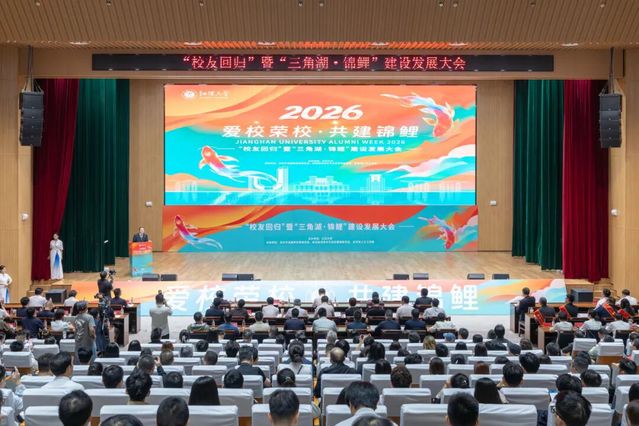
Guo Shuangxi, Vice Mayor of Wuhan; Qin Daoming, Secretary of the CPC Jianghan University Committee; Jing Xinhua, Deputy Secretary of the CPC Committee and President of the University; Wang Yang, Director of the Wuhan Municipal Development and Reform Commission; Sun Zhibo, Deputy Director of the Wuhan Economic & Technological Development Zone Administrative Committee; and Yang Renqiang, Vice President of Jianghan University, attended the conference.
On behalf of the Wuhan Municipal Government, Guo Shuangxi congratulated the university on the convening of the conference and sent greetings and best wishes to alumni returning to their alma mater and to friends from all sectors who have long cared for and supported Wuhan’s development.
Qin Daoming presided over the conference. On behalf of the university, he extended a warm welcome to the leaders, alumni representatives and guests present, and presented on-site awards to Zhang Handong, Huang Baoyuan, Shao Shengqiang, Wu Manman and other alumni honored as the 16th “Moving Jianghan University Figures.” He stressed that the “Triangle Lake · Koi” initiative is a major strategic component of Wuhan’s high-level effort to build a regional science and technology innovation center, and that its full implementation will inject strong momentum into the university’s high-quality development and add more JHU strength to that city-level endeavor. He expressed the hope that all “Koi Partners” will make full use of their resources, platforms and networks, tell the JHU story and make Wuhan’s voice heard, keep pooling high-quality resources, support their alma mater and power the region’s rise. Jianghan University, he said, is a university of the city of Wuhan and must hold to its goal of building a high-level urban university, integrating itself into the city and serving it, so that JHU proves “useful, dependable and indispensable” to Wuhan’s high-quality development and becomes an important strategic force in building the city into a regional science and technology innovation center. The university sincerely hopes that alumni will come home often and, as always, care for and support its development, and looks forward to continuing its partnership with friends from all sectors in writing a new chapter of district-university cooperation and university-enterprise mutual benefit.
In his address, Jing Xinhua reviewed the university’s development and its achievements. The conference centered on two themes: alumni homecoming and the building of “Triangle Lake · Koi.” It was both a reunion of returning alumni and a consultation on how to take on new development tasks and shoulder the mission of the times. The Koi project, he noted, is a mission the university must carry, and a broad platform for alumni to apply their talents, advance their careers and give back to their home city. First, he hoped alumni would engage actively and share the mission by offering advice and opening doors, helping more industrial projects, technological achievements and talent resources find their way to the university, so that the task assigned by the CPC Wuhan Municipal Committee and the Municipal Government is carried out thoroughly. Second, he hoped they would make good use of the platform to deepen collaboration, linking alumni chapters across the country with their alma mater, creating a sound pattern in which “workstations host, alumni contribute and all grow together,” and turning the alumni network into a living web that sustains the mission. Third, he hoped they would come back often and move forward with the university, making “coming home” a habit, returning to walk the campus and see what has changed, and offering candid advice, for the university will always be a strong backing for their careers.
Jing Xinhua signed cooperation agreements on behalf of the university with Hubei Jingchu Humanoid Robot Co., Ltd., Zhiyuan Innovation (Shanghai) Technology Co., Ltd., Leju Intelligence (Shenzhen) Co., Ltd., Shenzhen Yuejiang Technology Co., Ltd., Zibianliang Technology (Shenzhen) Co., Ltd., Zhishen Technology (Beijing) Co., Ltd., Beijing Duliang Technology Co., Ltd. and Zhongde Huajian Engineering Technology Group Co., Ltd.
Jing Xinhua, Wang Yang and Sun Zhibo presented letters of appointment as “Koi Partners” to alumni Qin Xuhui, Liu Xiangdong, Yang Linyun, Xing Baowei, Zhao Qian, Yang Jianfang, Hu Yongsheng, Zhu Han and Xu Jinchong.
Sun Zhibo gave a special presentation on WEDZ (Wuhan Economic and Technological Development Zone), and Yang Renqiang reported on the progress of the “Triangle Lake · Koi” project.
Four alumni — Qin Xuhui, Xu Jinchong, Zhu Han and Xing Baowei — shared their own experiences in research breakthroughs, innovation and entrepreneurship, and social service, in light of the core directions of the “Triangle Lake · Koi” project.
In February this year, Wuhan launched a special campaign to “unleash the vitality of industrial innovation” and named it the “Koi Plan.” The plan will focus on key fields such as the marine economy, the digital-intelligent economy, the water economy and spatiotemporal intelligence, building a group of distinctive sci-tech innovation parks that combine the functions of “an online Taobao, an offline Canton Fair and a sci-tech innovation mall.” “Triangle Lake · Koi” is one of them, a park jointly developed with local resources such as the Wuhan Economic & Technological Development Zone and Jianghan University. With a total investment of more than 1 billion yuan, the project sits on a 39-mu (about 2.6-hectare) plot in Phase IV of the South Taizi Lake Innovation Valley. Responding to the innovation-chain features of the embodied intelligence track, it will be organized into six functional zones: a robot body originality zone, an intelligent hardware testing workshop, an intelligent software testing workshop, an intelligent agent incubation center, an agent collaboration zone and an embodied application experience center.
Outside the main venue, the university mounted exhibitions of alumni-enterprise and on-campus research achievements, giving faculty, students and alumni a platform to showcase and connect. Research outcomes such as the university’s Rhein algae tea and embodied intelligent robots, and products from alumni companies such as bursting corn and lithium batteries, drew many guests, alumni and members of the university community. More than 500 people attended, including officials from relevant Wuhan municipal departments and the Wuhan Economic & Technological Development Zone, representatives of partner enterprises, alumni from home and abroad, and heads of university departments and schools together with faculty and student representatives. Themed “Love the University, Honor the University, Build the Koi Together,” the 2026 Alumni Week runs until October 24. Its program includes the 1024 AI Innovation Ecosystem Campus, a technology transfer manager training session, an employment promotion week for the Class of 2027, a campus open day for high school principals, the alumni-enterprise exhibition, cultural and sports exchanges, a campus food week, a reunion and campus tour for retired faculty who founded the university, and a series of school-level events, all designed to build a platform for alumni to connect and cooperate, deepen industry-education and university-city integration, empower alumni, the university and the city alike, and foster a shared community of affinity, education and development.
By Yi Jun, He Mingkan, Lyu Hongyan and Li Sha