

October 24th, designated as China’s 1024 Programmer Day, has become an important shared festival each year for developers, innovators, and entrepreneurs.
This year in Wuhan, programmers focused on AI, the “code of our era,” “programming” around four key directions: “AI + Open Source,” “AI + Industry,” “AI + Advanced Computing,” and “AI + Education.”
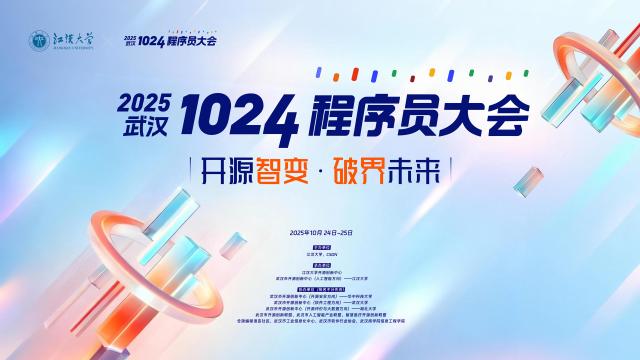
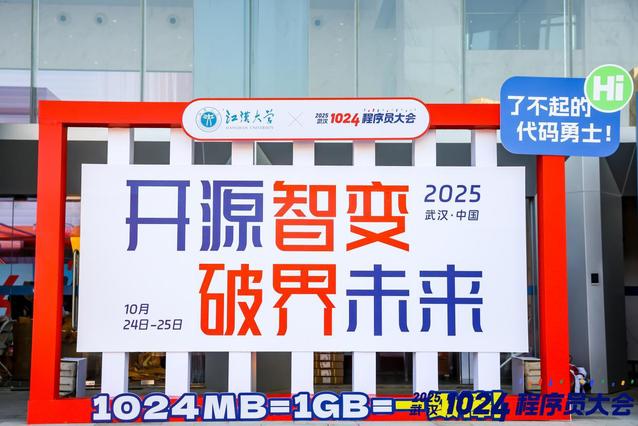
Held from October 24th to 25th under the theme “Open Source Intelligence, Transcending Boundaries for the Future,” the 2025 Wuhan · China 1024 Programmer Festival concluded successfully at Jianghan University.
Co-hosted by Jianghan University and CSDN, the event featured dedicated forums centered on these four directions, alongside special activities like AI large model experience zones, intelligent agent development competitions, and premium job interview sessions. It comprehensively showcased the innovative practices and contemporary value of AI and open-source technology in the integration of education, scientific research, and industry.
This grand festival for the programmer community also served as a high-level exchange platform in Wuhan for “AI + Open Source + Education,” bringing together over a thousand experts, scholars, and young developers from universities, research institutes, open-source communities, and renowned enterprises across China, with nearly three million online views.
AI + Open Source: Four University Open Source Innovation Centers Share the Stage for the First Time
“1024 is not just a festival for programmers, but also for innovators, representing the infinite possibilities of open-source collaboration and digital intelligence,” said Xiang Yue, Vice President of Jianghan University. She noted that the “Open Source Innovation Centers” established in universities are unlocking the boundless potential of “AI + Open Source,” promoting the deep integration of university education and urban industry in the field of artificial intelligence.
Centered on the principle of “Open Source Drives the Future,” the “AI + Open Source” forum witnessed the first joint appearance of Wuhan’s four university Open Source Innovation Centers.
Representing the core strengths of Wuhan in Artificial Intelligence, Open Source Security, Software Engineering, and Open Source Evaluation & Big Data respectively, Jianghan University, Huazhong University of Science and Technology, Wuhan University, and Hubei University shared the stage as constructing units of the “Wuhan Open Source Innovation Centers.”
Expert representatives from the four centers delved into topics ranging from cultivating open-source innovation talent in the AI era and establishing new talent evaluation systems centered on open-source contributions to building university open-source security systems and the latest achievements in AI-driven software engineering research. They explored new development paths for “AI + Open Source + Universities” in Wuhan.
As Chen Yulong, Deputy Director of the Expert Committee of Jianghan University’s Open Source Innovation Center, stated: “Open source, which facilitates the flow of knowledge from being closed to open, is pushing universities to transition from cultivating ‘engineers’ to cultivating ‘collaborators‘.”
Through this event, the four universities, alongside enterprises such as CSDN and Huawei’s Cangjie, jointly initiated the “University-Industry-Community Collaborative Innovation Alliance,” aiming to efficiently transform scientific research achievements into industrial applications and inject new momentum into Wuhan’s goal of becoming a national innovation hub for the digital economy.
“Based in universities, we aim to cultivate qualified Rust developers for the industry and jointly build China’s Rust open-source ecosystem,” introduced Zhou Daibing, Huawei Software Engineering Expert. He added that the Xuanwu Community will focus on building Rust community activities in China, promoting software industry innovation based on open-source security.
This single forum, featuring four universities, showcased the phased achievements of Wuhan’s “government-industry-university-research-application” collaborative mechanism within the open-source innovation system, marking the formation of a multi-dimensional and systematic landscape for open-source education and research collaboration in Wuhan.
This year, Wuhan officially launched the linkage construction mechanism for the “Four Major Open Source Innovation Centers,” jointly undertaken by Jianghan University, Huazhong University of Science and Technology, Wuhan University, and Hubei University. They will tackle research challenges and talent cultivation in fields like AI, open-source security, software engineering, and data governance, aiming to build a nationally leading open-source education and application ecosystem.
AI + Industry Application: AI Empowers All Industries, Intelligent Transformation Shapes the Future
Coinciding with the Nobel Prize season each October, both AI’s prominent wins in last year’s scientific Nobel categories and this year’s Economics laureate’s discourse on AI’s economic impact attest to its widespread application in technology and industry.
How is AI being used? The “AI + Industry Application” forum demonstrated AI’s application results and cross-border potential in multiple fields.
“AI is driving protein design into a ‘programmable’ era,” shared a relevant person in charge from Jianghan University’s Microalgae Synthetic Biology and Green Manufacturing Research Institute, using a programmer-friendly term to describe new research paths combining AI with microalgae bio-intelligent manufacturing. From assisting precise gene editing and optimizing metabolic pathways to aiding the design of efficient universal promoters and precisely designing high-activity enhancers—AI is “intelligently manufacturing” microalgae synthetic biology, according to his presentation.
Beyond universities, AI is widely applied across various industrial sectors.
During the event presentations, the domestic programming language “Cangjie” has formed an ecosystem. Having been officially open-sourced this year, Cangjie has already achieved breakthroughs in commercial applications within the HarmonyOS ecosystem. Yiyong Tech is promoting the empowering application of AI in the cancer prevention and treatment system, creating an integrated intelligent agent for full-cycle tumor management and scientific research. The "Smart Chef" project leverages AI to advance the digitalization of Chinese cuisine. Xu Zhihong, representing naodongdak.AI, sparked lively discussions by exploring the question "What else should AI do besides Vibe Coding?" from a philosophical perspective.
Programming language innovation, smart healthcare, green intelligent manufacturing, culinary digitization, AI philosophy frontiers... The “AI + Industry Application” forum focused on AI’s practical use in healthcare, manufacturing, culture, and other fields, witnessing a new industrial future shaped by AI’s deep integration into all walks of life.
“AI + Industry Application” is also a key strategy for Wuhan’s AI industry development. This year, Wuhan is deeply implementing the “AI Plus” initiative, accelerating efforts in four areas: promoting breakthrough AI applications, developing breakthrough AI products, constructing appropriately advanced digital infrastructure, and optimizing the AI development ecosystem. It focuses on utilizing data, creating scenarios, optimizing the ecosystem, and promoting implementation, charting five application tracks: AI + Robotics, AI + Automotive, AI + PC/Server, AI + Mobile, and AI + Glasses.
AI + Advanced Computing: Building the Computing Power Foundation, Empowering Industry Co-creation
“Advanced computing is undergoing a transition from ‘auxiliary tool’ to ‘core productive force’,” said Jing Xinhua, President of Jianghan University, at the “AI + Advanced Computing” forum. He stated that Wuhan, leveraging its solid foundation, including intelligent computing centers, supercomputing centers, and high-speed networks, is accelerating the construction of a central China computing power hub.
In his view, universities should provide intellectual support and talent leadership in this process, jointly promoting the development of the advanced computing industry through the deep integration of open architectures, independent computing power, and the open-source ecosystem.
Computing is the core of the information technology industry and the foundation of the digital economy era. With the evolution of global computing technology and industrial transformation, the strategic and fundamental role of the advanced computing industry is becoming increasingly prominent, crucial for promoting the leapfrog development of the information industry and empowering economic and social development.
How can AI accelerate the advanced computing industry? At the forum, multiple experts and enterprise representatives offered their answers in keynote reports.
Jiang Tao, Founder and Chairman of CSDN, proposed building a “self-controllable AI open-source ecosystem,” advocating for China’s AI transition from “user” to “contributor,” and creating a full-chain open-source system from the foundation to the ecosystem. Gong Chunye, Deputy Director of the National Supercomputing Center in Tianjin, introduced the concept and challenges of “Space-based Supercomputing,” showcasing cutting-edge exploration in satellite-ground collaborative computing for research and industry. Hu Hao, CTO of the Ascend AI Ecosystem Innovation Center, shared Ascend’s integrated development model of “Computing Power + Algorithms + Ecosystem,” aiding implementation in education, research, and industrial intelligent manufacturing scenarios. Lü Qiheng, General Manager of Moore Thread's Education and Research Cooperation, introduced innovations in domestic GPUs for AI computing and ecosystem collaboration, highlighting breakthroughs of the MUSA meta-computing architecture in high-performance computing.
“The breakthrough of advanced computing requires collaborative innovation in computing power, algorithms, data, and ecosystem” was the consensus among the experts. They viewed this forum as an important showcase of Wuhan’s achievements in building an independent computing power system and university research support, also providing a clear sample for the future path of “industry-education integration and industry co-creation.”
Simultaneously, Jiang Tao released the Global AI Open Source Ecosystem Report live.
The report indicates that the global open-source ecosystem shows a multipolar trend characterized by “US-China leadership, multi-country advancement, and distinct regional characteristics.” China ranks second globally in four indicators: active developers, open-source contributions, developer influence, and research papers, ranks first in contribution growth, and third in high-influence talent, marking a substantial shift from “participant” to “contributor” and even “leader.”
From participation to contribution and then to leadership, universities in Wuhan have become key bastions for open-source ecosystem construction. At Jianghan University alone, the past year has seen a series of achievements from “industry-university-research-application” collaborative innovation: the “Open Source and Intelligent Technology Innovation Laboratory” and the “Wuhan Open Source Innovation Center (AI Direction)” were established successively, and the Smart Healthcare Open Source Alliance and the Intelligent Connected Vehicles Open Source Alliance were officially inaugurated there.
AI + Education: Empowering a New Education Ecosystem with Intelligence
“AI + Education is developing towards more intelligent and personalized directions; the new future of teaching students according to their aptitude has arrived.”
Within universities, education also sparked heated discussion among participants, who shared and explored the infinite possibilities for the education industry.
Focusing on “AI Empowers Education Innovation and New Models of Industry-Education Integration,” the “AI + Education” forum brought together experts, scholars, and frontline educators from educational, industrial, and research institutions to discuss the profound impact of AI technology on education systems, teaching models, and talent cultivation.
Through the “course services — talent profiling — position profiling — industry demand model,” a two-way driver system between education and industry is being constructed, forming a closed-loop talent development mechanism from the classroom to the industry. Education will transition from “screen-based interaction” to “spatial immersion,” enabling students to achieve cognitive leaps through authentic perception. A dual-integrated, compound talent cultivation system combining “AI + security” is being built, forming a composite talent structure equipped with both offensive/defensive practical skills and algorithmic capabilities. An “Algorithm and Mindset” learning power model is being developed, utilizing AI to assist in cognitive training, learning strategy optimization, and personalized growth path design... During the event, participating guests successively shared the extensive applications of artificial intelligence in areas such as classroom teaching, practical training, and educational assessment, showcasing multiple pathways for the digital transformation of education.
“AI has leapfrogged from being a ‘tool layer’ assisting instruction to becoming the ‘intelligent foundation’ reconstructing the education system.” Participating experts generally believe that universities should proactively plan for educational data governance, the construction of teaching agents, and new mechanisms for industry-education integration, thereby promoting the transformation of education from “knowledge imparting” to “ability generation” and value co-creation.”
To allow more students to perceive, apply, and master AI, a dedicated “AI Large Model Experience Theme Activity” was held during the festival, attracting 200 “Young AI Explorers” from Jianghan University’s Experimental Primary School and Experimental Middle School.
AI songwriting, voice cloning, text-to-image generation, video face swapping, AI doodle-to-painting creation... These interactive activities were carried out around five exhibition booths. Students held the “AI Exploration Passport” stamp cards and operated on-site to experience AI’s creative and interactive capabilities. What started as a grand gala for programmers has also become an engaging classroom for students to experience AI applications and learn scientific and technological knowledge.
Competitions + Interviews: Building a Platform for University Talent Innovation and Entrepreneurship
A grand event for innovators and thinkers also became a stage for students’ innovation and entrepreneurship, witnessing the diverse vitality of Wuhan, a city of universities.
Alongside the four main forums, the event concurrently held multiple competitions, exchanges, and recruitment activities, attracting extensive participation from students of many universities in Wuhan.
During the conference, AI innovation achievements from universities were showcased in a concentrated manner, and the final and award ceremony of the “1024 Open Source π Party · Intelligent Agent Development Competition”, hosted by the Open Source Innovation Center of Jianghan University, was successfully held.
The competition attracted 31 teams from universities, including Jianghan University, Hubei University, Wuhan Business University, Guilin University of Electronic Technology, and South China University of Technology, with nearly 200 students participating. After fierce competition, the top three prizes were won by teams from Jianghan University, Guilin University of Electronic Technology & South China University of Technology, and Wuhan Business University.
On October 25th, the “Career Path to the Future, Dream Sets Sail — Wuhan 1024 Programmer Festival Premium Interview Session” was successfully held at Jianghan University. Aimed at “building a bridge” between students and high-quality enterprises, it focused specifically on programmer talent cultivation and employment matching, becoming a new model of university-enterprise collaborative education and effectively promoting the deep integration of the talent chain and innovation chain.
The interview session brought together experts and corporate executives from Jianghan University, CSDN, OpenAtom Open Source Foundation, Qidian Intelligent Research Institute, Huawei Cangjie, and Fujian Guoke, forming a powerful judging panel. Nine outstanding students were selected to deliver on-site presentations. The event innovatively adopted a “live card-raising” mechanism, allowing corporate representatives to express hiring intent immediately. Ultimately, all nine students received recognition from the companies.
Promoting Innovation through Open Source, Cultivating the Future with Intelligence
Over the two days, the 2025 Wuhan · China 1024 Programmer Festival concluded successfully. Through the linkage of four themed forums and three featured activities, it comprehensively showcased Wuhan's latest achievements in open-source ecosystem construction, computing power innovation, AI industry implementation, and education integration.
The festival not only facilitated deep cooperation between universities and industries but also further solidified Wuhan's strategic position as a “National Open Source Innovation Highland and Intelligent Education Demonstration Zone.”
According to aJianghan University official, the university will continue to collaborate with government departments, industrial enterprises and open source communities to promote the coordinated development of “AI + Open Source + Education,” thereby driving high-quality leapfrog progress in the region’s digital economy, science and technology and education.
By: Rao Fan, Gao Xi, Li Sha